|
BIRD FACTS |
Description
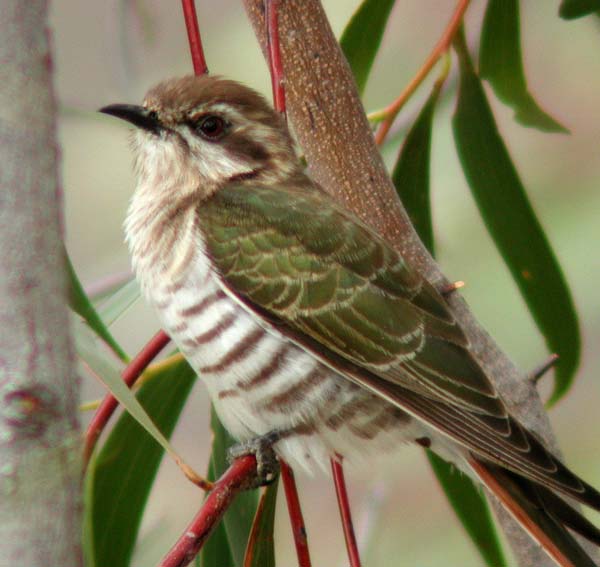
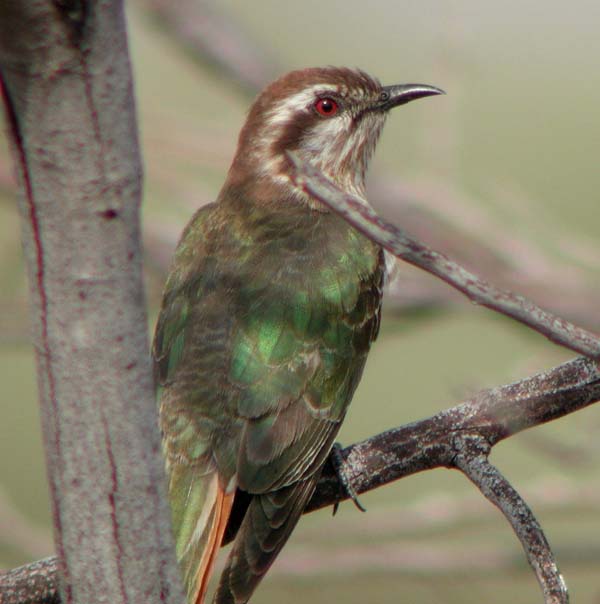
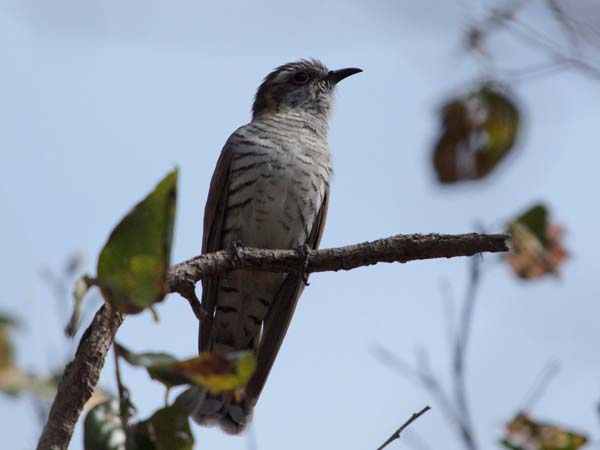
Horsefield's Bronze-Cuckoo is olive-brown above with pale scale pattern, with a bronze to green sheen on the back. It has a dark-brown eye stripe and white eyebrow stripe above the eye. The underside is white to cream with dark-brown barring at the sides, with the bars joining in the middle on the upper breast only. The tail is edged orange brown. Juveniles are duller with little or no barring on sides of body.
Size
18cm
Habitat
open woodland and forest where there is understorey of grass, heath or shrubs.
Food
insects, larvae, caterpillars, some plants
Breeding
Parasitises other bird species. Often targets birds that build dome nests such as fairy-wrens and thornbills, but also uses open cup nests of other species. The female lays one egg in the host nest. She removes one of the eggs of the host. The host parents incubates the cuckoo egg and feeds the young. The newly hatched cuckoo ejects the eggs or nestlings of the host by heaving them over the edge of the nest with its back and wings.
Range
widespread on the eastern side of the Great Dividing Range in Queensland, and down through New South Wales and Victoria to Tasmania and South Australia. Widespread in the Northern Territory and Western Australia except in the most arid areas.

Credits:
Map is from Atlas of Living Australia website at https://biocache.ala.org.au licensed under Creative Commons Attribution 3.0 License.
Classification
| Class: | Aves | | Order: | Cuculiformes | | Family: | Cuculidae | | Genus: | Chrysococcyx | | Species: | basalis | | Common Name: | Horsfield's Bronze-Cuckoo |
Relatives in same Genus
Shining Bronze-Cuckoo (C. lucidus)
Little Bronze-Cuckoo (C. minutillus)
Black-eared Cuckoo (C. osculans)
|
|