Australian Wasps
|
|
FAMILY : Braconid Wasps
|
Braconid Wasp
(Braconidae family ) |
|
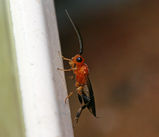
This Braconid Wasp may be a species of Callibracon? It has orange head and thorax and greyish abdomen. The rear legs have dark bands. It was seen flying round outdoor lamp at night. Click to continue> |
|
Braconid Wasp
(Callibracon sp) |
|
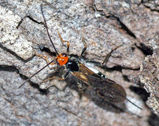
This Braconid Wasp has orange head with black eyes. The thorax is black, and the abdomen is black above and white on the flanks and underside. There are black and white bands on the rear part of the abdomen. Click to continue> |
|
|
FAMILY : Flower Wasps
|
Blue Ant
(Diamma bicolor) |
|
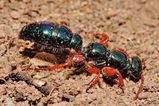
Blue Ants are not ants at all but the wingless females of a species of Flower Wasp. The female is has a glossy blue green body with reddish legs. They move across the ground with a rapid restless motion with abdomen raised above the ground. The... Click to continue> |
|
Native Flower Wasp
(Thynnus zonatus) |
|
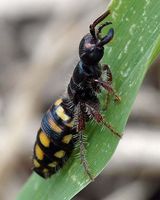
Thynnus zonatus is an Australian native flower wasp. The wingless female is black with bright yellow marking in bands on the abdomen. The males are smaller and have wings. They are parasitic wasps laying eggs on beetle larvae. They are sometimes... Click to continue> |
|
Flower Wasp
(Tiphiidae family ) |
|
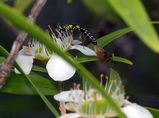
Flower Wasps are parasitic wasps. Many species parasitize the larvae of burrowing beetles. The females are stout and wingless with legs adapted for digging. They are often seen with the male Flower Wasp flaying around carrying the wingless female... Click to continue> |
|
|
FAMILY : Gasteruptiid Wasps
|
Gasteruptiid Wasp
(Gasteruptiidae family ) |
|
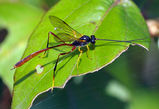
This wasp has black head and thorax. The front four legs are yellow and hindlegs are orange brown with yellow tips. The body is orange-brown. Females have a short ovipositor. The antennae are nearly as long as the body. Click to continue> |
|
Gasteruptiid Wasp
(Gasteruption sp) |
|
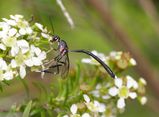
This Gasteruptiid wasp is mainly grey with white "feet". It has a long thin abdomen and long legs. The male has a white tipped abdomen and the female has a white-tipped ovipositor that is as long as the body. Click to continue> |
|
|
FAMILY : Ichneumon Wasps
|
Black and White-striped Ichneumon Wasp
(Gotra sp1) |
|
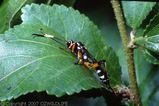
The Black and White-striped Ichneumon Wasp is black with white spots on the thorax and broad black and white bands on the abdomen. The antenna are black with white band. Females have ovipositor is less than half the body length. This wasp is similar... Click to continue> |
|
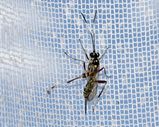
Black and Yellow-striped Ichneumon Wasp
(Gotra sp2) |
|
This Black and Yellow-striped Ichneumon Wasp is black with creamy yellow spots on the thorax and narrow creamy yellow bands on the back part of the abdomen. The antenna are black with white band. Female ovipositor is less than half the body length.... Click to continue> |
|
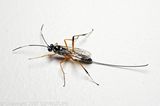
Banded Caterpillar Parasite Wasp
(Ichneumon promissorius) |
|
This Ichneumon Wasp has black body with white spots. The legs are orange and the antenna are black with a broad white band. Females have a long ovipositor (egg laying tube) that is longer than the body. The male does not have an ovipositor. Click to continue> |
|
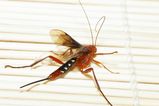
Orchid Dupe Wasp
(Lissopimpla excelsa) |
|
The Orchid Dupe Wasp is a medium sized wasp with mainly orange body and dark wings. The abdomen has broad black band with four white spots on each side. The long thin antennae curl upwards at the ends. Females have a stout black ovipositor that is... Click to continue> |
|
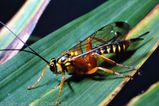
Ichneumon Wasp
(Xanthopimpla sp) |
|
This Ichneumon Wasp has black and yellow stripes on head and thorax. the abdomen is black with five yellow bands. the end part of the abdomen is brownish red. The female has a strong ovipositor that is less than half the body length. The antennae... Click to continue> |
|
|
FAMILY : Mud-Dauber, Sand Wasps
|
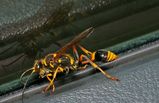
Mud Dauber Wasp
(Sceliphron sp) |
|
The Mud Dauber Wasp is a large black or dark brown wasp, banded with yellow. It has a then waist an long legs. In summer it is often seen around wet soil, pools, bird baths as it collects mud to make its nest. Click to continue> |
|
|
FAMILY : Paper Wasps, Potter Wasps
|
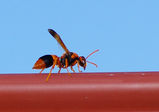
Potter Wasp
(Abispa ephippium) |
|
The Potter Wasp is a large wasp. The abdomen is orange and black, and the thorax is black with orange triangle at the shoulders. The antenna and legs are orange-yellow. Potter Wasps are solitary and build a mud pot-shaped nest attached to a tree... Click to continue> |
|
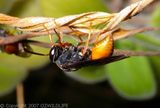
Potter Wasp
(Paralastor sp) |
|
Potter Wasps are solitary wasps related to the paper wasps. They build mud nests which they stock with caterpillars and grubs as food for the larvae. When the egg is laid they seal the entrance with mud. Click to continue> |
|
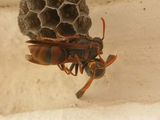
Common Paper Wasp
(Polistes humilis) |
|
Common paper wasps are social insects, that are common around the outside of homes and in gardens. These slender wasps have long thin wings and are tan with darker bands and some yellow markings on the face. Their paper nests are often seen hanging... Click to continue> |
|
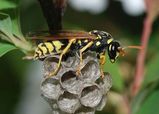
European Paper Wasp
(Polistes dominulus) |
|
The European Paper Wasp is a black and yellow striped wasp with distinctive orange antennae. It is slightly longer than a honeybee. The European Paper Wasp is often confused with the European wasp (Vespula germanica), but there are some significant... Click to continue> |
|
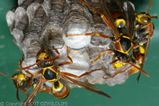
Paper Wasp
(Polistes sp) |
|
This paper wasp is black or brown, with yellow bands. They can give a painful sting if you disturb the nest. If you want to get rid of ones near the house, it is safest to spray them at night when they are at rest. Click to continue> |
|
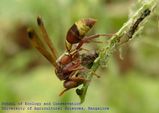
Tropical Paper Wasp
(Polistes stigma) |
|
Polistes stigma is a small paper wasp. It is rich brown colour with lighter orange brown legs and antennae. The end of the abdomen is banded with yellow. The wings have a dark spot near the tip of each forewing. Click to continue> |
|
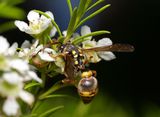
No common name
(Ropalidia socialistica) |
|
Ropalidia socialistica is a black and yellow wasp. It has six yellow spots on the thorax and there is knob shaped segment between the main abdominal part and the waist. Ropalidia socialistica can inflict a painful sting. Click to continue> |
|
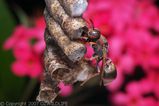
Paper Wasp
(Ropalidia revolutionalis) |
|
The paper wasp is a smallish dark brown wasp with some lighter brown markings. It often suspends its paper nest from hanging baskets, eaves or plants around the house. They can give a painful sting if you disturb the nest. If you want to get rid of... Click to continue> |
|
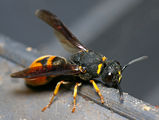
Mason wasp
(Vespidae family sp2) |
|
This Mason Wasp from the Eumeninae subfamily of the Vespidae family is a large black and orange wasp. The head and thorax are mostly black with dimpled texture. There is a yellow banana shaped marking on the face and a yellow spot between the... Click to continue> |
|
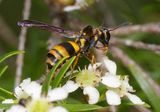
Paper Wasp
(Vespidae family sp1) |
|
This wasp has bold black and yellow bands. No idea what species it is. If you have any ideas let me know. Click to continue> |
|
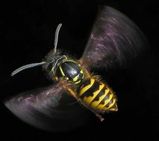
English Wasp
(Vespula vulgaris) |
|
The English Wasp is a social insect with bold black and yellow bands. It is similar in appearance to the related European Wasp (Vespula germanica). You can tell them apart by the pattern on the back - the European Wasp has black dots in the yellow... Click to continue> |
|
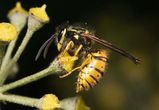
European Wasp
(Vespula germanica) |
|
The European Wasp is a social insect with bold black and yellow bands. The black bands have arrow-shaped black markings down the centre of the abdomen, and there are pairs of small black spots on the yellow bands. The wings are long and transparent,... Click to continue> |
|
